Prologue
Vault-3 Workspace, Nevada — March 2029
[Click.]
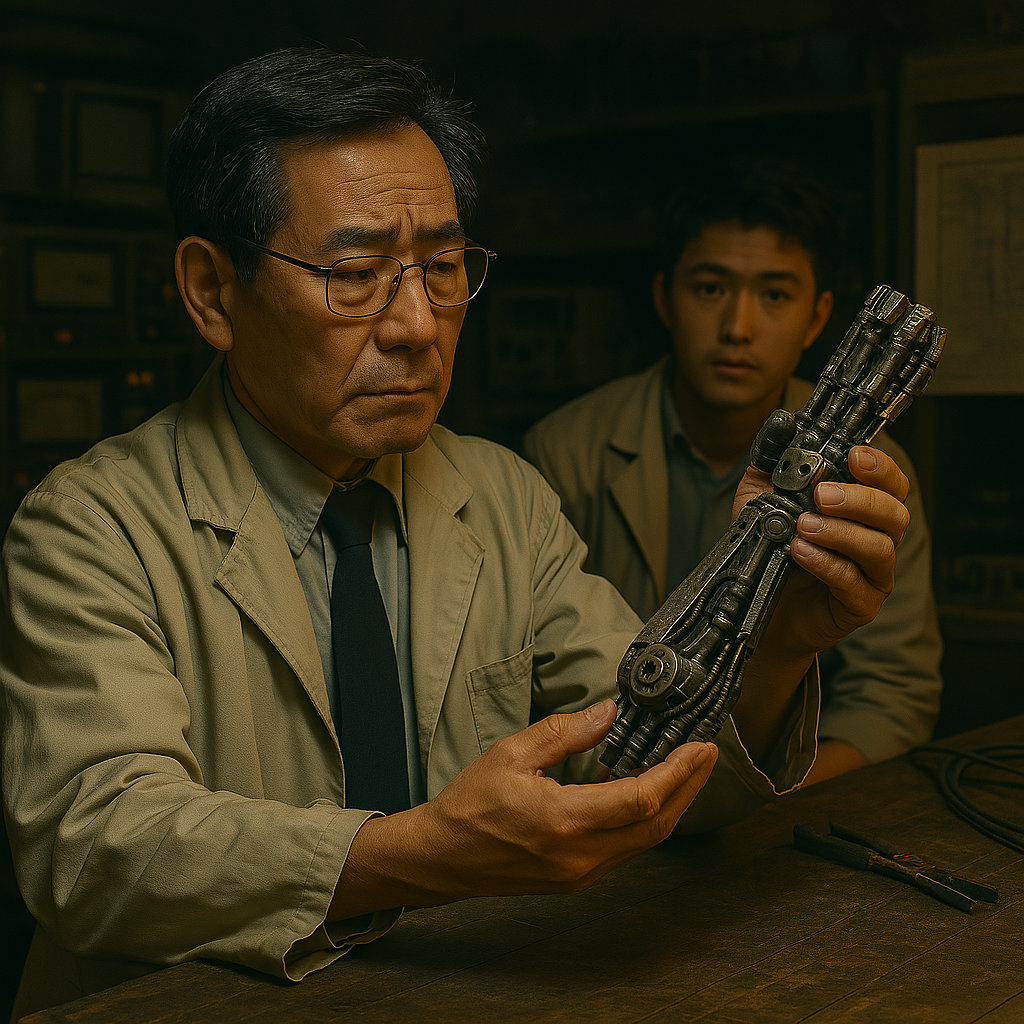
"Nakamura, K. Personal record, March the fourteenth. I am noting this outside of standard procedural documentation. The subject is male, late adolescence. The integration involves bilateral upper limb augmentation — full arm replacement, shoulder joint to fingertip, with spinal anchoring at C4 through T2. The GPI classification is field-grade. I have been asked not to use the word voluntary in my notes."
[Click.]
He set the recorder down on the bench and did not look at it again.
Once, his work had made headlines.
He had rebuilt the motor functions of stroke victims. Given movement to children who had never walked. The awards came. The grants. The reverence. He had stood in rooms full of important people and accepted their applause with the quiet certainty that he was doing something that mattered.
It should have ended there — in clinics, in recovery wards, in the careful hands of people who needed a second chance at ordinary life.
But somewhere along the line, the patient became an asset. The limb became a loadout. And everything he had built was repurposed into something colder, by people who had never once asked his permission.
The workspace had been cleared for the procedure. Equipment pushed to the walls, the bench wiped down, a portable surgical rig assembled in the centre of the room. It wasn't a theatre — nothing so deliberate. Just a room that had been made to work. A single overhead light hummed above the table, casting everything in a flat, pale glow. Cabinets lined the far wall, still stacked with his notes and reference texts, the detritus of years of legitimate work. On the far wall, a narrow case held a gleaming prototype — a full arm rig, shoulder to fingertip, the last one he had completed before the GPI began demanding field deployment. He had built it here, at this bench. He had imagined it going to someone who needed it.
He had done this before. Too many times.
But this one stayed with him. Because it was the first time the GPI had told him why.
Not recovery. Not healing. Preservation — of something bigger, something global, something that required a certain kind of soldier and couldn't wait for volunteers. They hadn't pressured him. Not exactly. But the weight of it — the rhetoric, the urgency, the unspoken arithmetic of catastrophe — made refusal feel like negligence. Like stepping back while the world burned.
The kind of protection they spoke of didn't serve the host. It used them.
The host was young. Barely out of adolescence, silent in the way that said more than screaming ever could. He had looked up once — just once — with eyes that weren't asking for strength, or power, or even survival.
Just to be left whole.
Nakamura looked away. Then he put him under.
The procedure took over four hours. Both arms removed at the shoulder, the spinal anchors placed first — four points along the cervical and thoracic vertebrae, each one threaded with neural binders thinner than a human hair. The augmented limbs would draw from the spine directly, fed by the host's own nervous system, integrated so completely that removal would kill him. Not immediately. But certainly. The body would no longer know how to be a body without them.
Neural mapping surged and stuttered throughout. Every step recalibrated on the fly — one wrong signal and the host's nervous system could misfire permanently. The calibration sequence whispered through the workspace like a breath Nakamura hadn't yet taken, tension coiling behind every movement, measured in microvolts and risk. When it was done, the GPI liaison in the corner of the room noted the time and called the integration flawless.
Nakamura knew better. Sweat clung to his collar. His hands ached.
He had paused once during the procedure. Not to rest or to think. Just to look at what he was building.
What he had constructed wasn't a prosthetic anymore. Triple the torsion threshold of a natural limb. Reactive torque speeds beyond any combat standard. Not strength to lift, or carry, or protect. Strength to break. To overwhelm. A test subject wrapped in protocol and silence, sent out to become a number in someone else's calculus. It wasn't restoration. And the man doing it was no longer quite the surgeon he had been before he walked into this room.
He could have left. Many had.
But Nakamura had seen what happened when ethics walked out first. So he stayed — not to accelerate the work, but to slow it. To keep his breakthroughs from becoming a blueprint. He throttled progress. Redirected experiments. Buried designs under bureaucratic knots and clinical language.
It worked, for a while.
He told himself he was the last restraint between his science and something irreversible. Maybe that was true. Maybe it was the story he needed to keep showing up.
The host's designation appeared later in the manifest of a ruined outpost outside Vault-3. His body was never recovered.
The same room — 2063
The window seal had given up years ago. A thin blade of light cut across the floor, illuminating dust that had settled slowly over decades, undisturbed and deep. The cabinets hung as they'd been left — some open, some not, papers still stacked inside, corners curled with age and damp. A coffee cup sat on the edge of the bench, long since dry, as though someone had stepped out and simply never come back.
The shelves on the far wall still held what they'd always held. A cracked spine bearing a name that meant nothing now — an early textbook on neuro-interface surgery, once praised, long forgotten. Beneath a fallen display screen, faded clippings clung to the wall: headlines about breakthroughs, about a man the world had briefly believed in, about awards that no longer existed to be given.
In the centre of the room, the prototype case listed to one side. Something had made a home beneath it once — generations ago, by the look of the compressed debris — and whatever it was had long since gone. The case had never been righted. The glass was scratched and filmed with dust, but the arm inside remained untouched. Steel alloy and fibered muscle-weave, fingers curled slightly, as if reaching for something just out of frame.
The silence around it felt charged.
In the drawer beneath the bench, the tape recorder sat where he always put it when he was done. The label, written in careful block letters, read only: K.N. — Personal.
The drawer clicked shut.
"I never wanted to make weapons. I wanted to give people their lives back. Somewhere along the line, we stopped asking who paid for that." — Dr. Kenji Nakamura, unarchived annotation, Vault-3